Which Type of Surface is Best for Sloped Driveways?
November 18, 2025 Driveway Resurfacing 5 min read
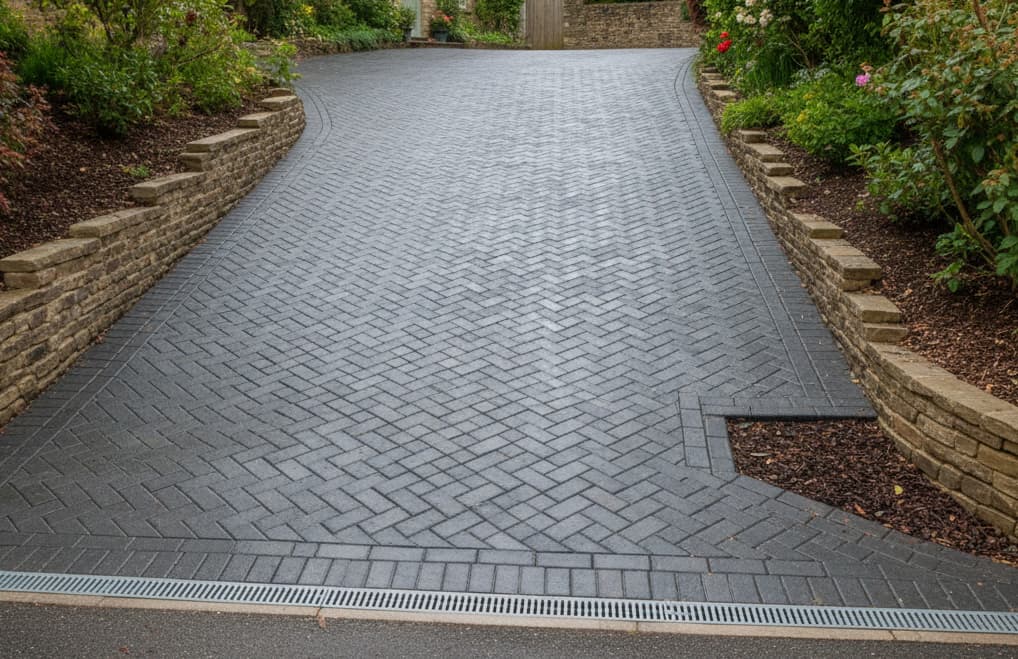
Building or resurfacing a sloped driveway presents engineering challenges that do not exist on flat ground. Gravity affects both the stability of the surface material and the behaviour of water runoff. If the wrong material is used, the driveway may suffer from erosion, structural movement or poor traction during wet, snowy and icy conditions.
This guide evaluates the most common driveway materials used in the UK, analysing their suitability for inclines based on traction, drainage, durability, and relative cost.
Key Considerations for Inclines
Before selecting a material, three factors must be addressed:
- Gradient (Steepness): Slopes are measured as a percentage (rise divided by run):
< 5% (Mild): Most standard materials are suitable.
5% – 10% (Moderate): Traction becomes a priority and loose materials will migrate.
> 10% (Steep): High-friction surfaces and structural stability are essential. - Traction: The surface must provide adequate friction (grip) for tyres and pedestrians, particularly in wet or freezing conditions.
- Drainage: Water moves faster on a slope. The surface must either be permeable (allowing water to drain through) or have effective channels to direct runoff to a drain, preventing erosion at the base.
Gravel (Loose vs Stabilised)
The Problem with Loose Gravel
Standard loose gravel is generally unsuitable for sloped driveways. Gravity and vehicle movement cause the stones to roll downhill, creating ruts at the top and piles of aggregate at the bottom. Round stones (pea shingle) act like ball bearings, significantly reducing tyre grip.
Use Cellular Grids Instead
Gravel can be a viable, cost-effective solution for slopes if a cellular confinement system (gravel grids) is used. These are interlocking plastic honeycombs laid over the sub-base.
- How it works: The grid holds the gravel in distinct cells, preventing migration.
- Requirement: You must use angular gravel (which locks together) rather than round stone.
- Pros: Excellent drainage (SuDS compliant), low initial cost compared to paving, prevents erosion.
- Cons: Requires periodic raking and “topping up” of stone.
- Cost: Low to Medium.
Asphalt (Tarmac)
Asphalt is a continuous, flexible surface often used for its cost-efficiency on large areas.
- Suitability: Best for mild to moderate slopes. On steep gradients (>10%), the installation is difficult as the hot material can slide before it cures.
- Traction Warning: Standard smooth asphalt can be slippery when wet. For slopes, specify a High Friction Surface (containing calcined bauxite) or a “surface dressing” where stone chippings are rolled into the hot asphalt for texture.
- Durability: Edges are the weak point on a slope. Reinforced concrete kerbs are required to prevent the edges from crumbling under lateral pressure.
- Cost: Medium.
Concrete
Concrete is a rigid, structural option. Because it is a solid slab, it does not suffer from the migration issues of gravel or the flexibility issues of asphalt.
- Surface Finish: A standard smooth finish is dangerous on a slope. You must request a textured finish:
– Broom Finish: A stiff broom is dragged across wet concrete to create horizontal ridges for grip.
– Exposed Aggregate: The top layer of cement is washed away to reveal the stones underneath, creating a high-grip, rugged surface. - Pros: Extremely durable, handles heavy loads well, low maintenance.
- Cons: Difficult and expensive to repair if cracks appear. Not permeable (requires distinct drainage channels).
- Cost: Medium to High.
Block Paving (Interlocking Pavers)
Block paving consists of individual concrete or clay bricks locked together with sand.
- Structural Integrity: For slopes, pavers should be laid in a Herringbone pattern (interlocking 45 or 90-degree angles). This pattern distributes weight and prevents the blocks from twisting or sliding when vehicles brake.
- Drainage: Permeable block paving is highly effective on slopes. It allows water to pass through the joints into the sub-base, preventing surface water from rushing to the bottom of the driveway.
- Pros: High aesthetic appeal, excellent traction, individual blocks can be replaced if damaged.
- Cons: Requires a very precise, compacted sub-base installation to prevent sinking.
- Cost: High.
Material Decision Matrix
The following table compares the surfaces based on performance on a gradient.
| Surface Material | Grip/Traction | Erosion Resistance | Drainage Capability | Maintenance Level | Relative Cost |
| Loose Gravel | Poor | Poor | Excellent | High | Low |
| Stabilised Gravel (Grids) | Good | Good | Excellent | Medium | Low-Medium |
| Asphalt (Textured) | Medium | Medium | Low (Impermeable) | Medium | Medium |
| Concrete (Broom/Aggregate) | Excellent | Excellent | Low (Impermeable) | Low | Medium-High |
| Block Paving | Very Good | Very Good | Good (If Permeable) | Low | High |
Key Questions to Ask Your Installer
When hiring a contractor for a sloped driveway in the UK, the stakes are higher. If the drainage or sub-base is incorrect, the driveway may suffer structural failure or cause flooding. Use this checklist to vet potential installers.
How will you ensure this driveway complies with SuDS regulations?
Look for: Use of permeable materials or drainage channels (Aco drains) directed to a soakaway within your property.
For this slope, do we need a linear drain at the bottom?
Look for: A clear plan for where the water will go (e.g., into a soakaway crate buried underground).
What depth of sub-base will you install?
Look for: A minimum of 150mm (6 inches) of compacted stone. Slopes often require deeper excavation.
Will you be using MOT Type 1 or MOT Type 3 stone?
Context: MOT Type 1 is standard for concrete/tarmac. MOT Type 3 is open-graded for permeable driveways.
How will you secure the sides of the driveway?
Look for: Concrete-bedded kerbs or pin kerbs installed before laying the surface. Wooden boards are not sufficient for permanent driveways.
Let’s Recap
For steep gradients, textured concrete or interlocking block paving offer the highest levels of safety and stability. While they require a higher initial investment, they eliminate the migration issues found in cheaper materials.
If a budget-friendly option is required, stabilised gravel using cellular grids is the only effective alternative. Avoid standard loose gravel and smooth asphalt on any significant incline to prevent long-term safety and maintenance issues.
Get your free surfacing quote
Let our team of experts handle your surfacing — get a free quote today.